You’ve heard about sound baths. Maybe a friend came back from one glowing. Maybe you’ve seen them pop up on your Instagram feed or noticed the sessions at Lionheart Yoga & Sound Healing and wondered what actually happens inside one. If you’ve been curious but not quite sure what to expect or whether it’s even for you this guide is written exactly for you.
Sound baths are one of the fastest-growing wellness experiences right now, and for good reason. They’re deeply restful, require no prior experience, no spiritual background, and no particular skill. You simply lie down and let the sound do its work. But knowing what to expect before you arrive can make the whole experience feel less unfamiliar and help you get far more out of it from your very first session.
This guide covers everything: what a sound bath actually is, how it works physiologically, what the session looks like from start to finish, what to bring, what you might feel during and after, who they’re suited to, and how to get the most out of your experience. Let’s get into it.
What Is a Sound Bath?
First things first a sound bath has absolutely nothing to do with water or an actual bath. The word “bath” refers to sound washing over you, surrounding you completely the way water surrounds you when you submerge. You’re bathed in vibration and tone rather than liquid.
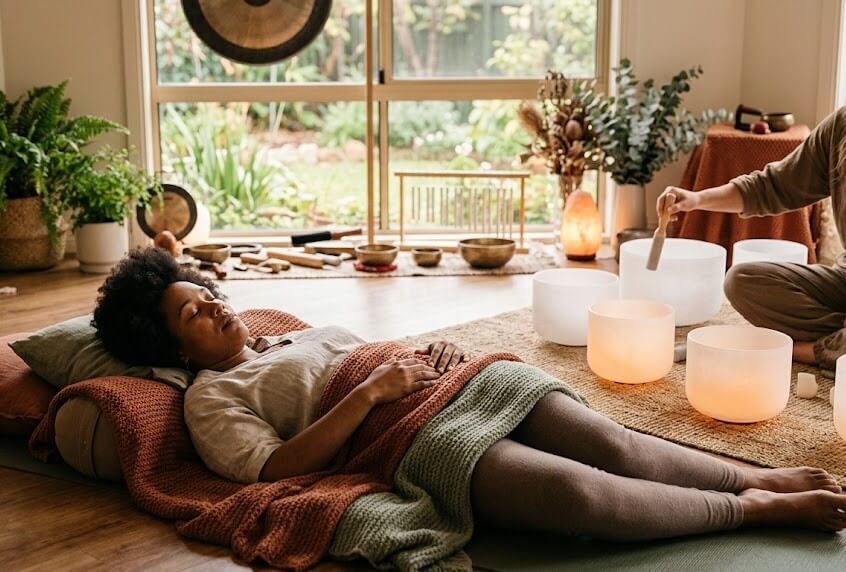
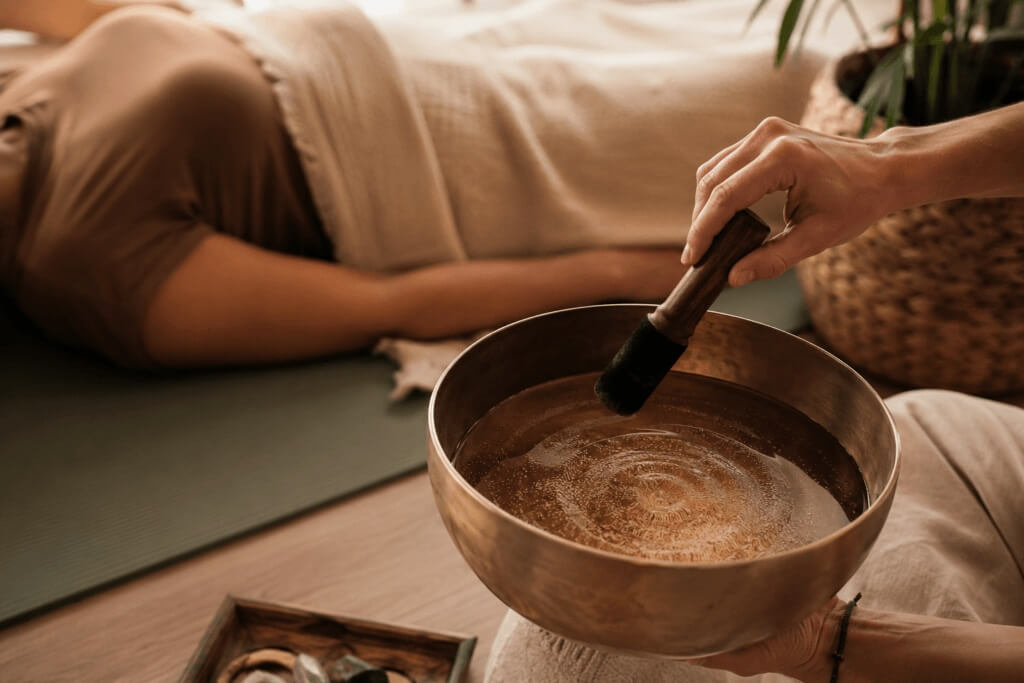
In practice, a sound bath is a meditative experience where you lie down usually on a yoga mat with a blanket and pillow while a practitioner plays a collection of instruments designed to produce rich, resonant, layered tones. These aren’t songs with melodies or lyrics. The sounds are sustained, overlapping frequencies that your nervous system responds to below the level of conscious thought.
The instruments typically used include crystal singing bowls, Tibetan singing bowls, gongs, ocean drums, Koshi chimes, tuning forks, rainsticks, shamanic drums, and often the practitioner’s own voice through toning or mantra. At Lionheart, sessions use an extensive collection that includes Australian quartz crystal bowls, a 30-inch Paiste earth gong, a 20-inch wind gong, a crystal harp, a shruti box, a monsoon stick, and more each adding a different quality and frequency to the sound environment.
The experience is sometimes described as “a lazy form of meditation.” You don’t need to clear your mind, hold any posture, concentrate, or achieve any particular state. You just receive. This makes sound baths particularly appealing for people who find traditional seated meditation difficult those with busy minds who struggle to “switch off” through willpower alone will often find sound baths take them somewhere they couldn’t get to on their own.
How Does a Sound Bath Actually Work? The Science Behind It
This is the part people are often most surprised by there’s genuinely solid science behind why sound baths feel the way they do, and why the effects aren’t just placebo.
The primary mechanism is called brainwave entrainment. Your brain produces electrical activity in different wave frequencies depending on your mental state. During a normal waking day, your brain operates mostly in beta state alert, thinking, problem-solving, busy. When you relax deeply, it shifts into alpha waves. During deep meditation and the edge of sleep, it produces theta waves. In the deepest sleep stages, it reaches delta.
The sustained tones of singing bowls and gongs create what’s called a binaural beat effect when your brain is exposed to two slightly different frequencies simultaneously, it tends to synchronise its own electrical activity to the difference between them. This isn’t something you consciously control or decide. It happens automatically, at a neurological level. This is why many people find themselves entering a deeply meditative state far more quickly in a sound bath than they would through traditional meditation practice alone.
Beyond brainwave entrainment, sound baths also activate the parasympathetic nervous system the branch of the autonomic nervous system responsible for the “rest and digest” response. Most of us spend the majority of our days in mild sympathetic (fight-or-flight) activation: slightly elevated cortisol, heightened alertness, muscles subtly braced. Sustained, low-frequency sound particularly from gongs and large crystal bowls has been shown to shift this balance, slowing the heart rate, lowering blood pressure, and releasing muscular tension in a way that’s difficult to achieve through mental effort alone.
A 2016 study published in the Journal of Evidence-Based Integrative Medicine found that participants reported significantly less tension, anger, fatigue, and depression after a sound meditation session using a Tibetan singing bowl, compared to before the session. Feelings of spiritual wellbeing also increased significantly, and the effects were most pronounced among participants who had never tried sound therapy before meaning beginners often get the biggest initial benefit.
There is also evidence that the vibrations from singing bowls particularly when placed near the body can reduce blood pressure and heart rate directly, through activation of the vagus nerve and the parasympathetic pathways it connects to. This is increasingly being explored in the context of trauma recovery and nervous system regulation.
The short version: a sound bath is not a passive experience. Even though you’re lying still doing “nothing,” your brain and nervous system are actively shifting into states of deep rest and repair that are measurably different from ordinary relaxation.
What Happens During a Sound Bath Session Start to Finish
One of the most common questions first-timers have is simply: what is the actual sequence of events? Here’s exactly what to expect when you come to a sound bath in Fremantle with Lionheart.
Arrival
You’ll arrive at the venue 5 to 10 minutes before the session begins. Sessions are held at beautiful, carefully chosen venues across Fremantle and the inner southwest including Bicton Church Hall, Cockburn Wetlands Centre, Fremantle Yoga, and Mala Yoga in Newtown. Each space is warm, intimate, and intentionally calm from the moment you walk in.
You’ll find a space on the floor to lay out your mat, place your pillow, and settle in under your blanket. The room will likely be softly lit most sessions are candlelit with instruments arranged at the front of the space. There’s a quiet, unhurried atmosphere; no one is rushing, no one expects you to make conversation. You can simply settle in and start to arrive.
The Opening
Once everyone is settled, Lyndal will open the session with a brief grounding or breathing exercise. This might be a simple body scan, a few slow breaths, or a short guided visualisation designed to help you release the mental momentum of your day and bring your attention into the present moment. This transitional phase is one of the most underrated parts of the experience even five minutes of intentional settling makes a significant difference to how quickly you drop into the sound.
The Sound Journey
Then the sound begins. In a 90-minute session, the sound journey itself typically runs for around 60 to 75 minutes. It’s not a performance there’s no applause, no structure to follow, no point at which you need to do anything. You close your eyes (an eye pillow helps enormously), let your body soften into the floor, and allow the sound to do what it does.
The journey usually has a natural arc. It begins gently perhaps just one bowl, or soft chimes gradually building in complexity and depth as more instruments are layered in. The gong often appears at a deeper point in the session, and its large, complex wave of overtones tends to produce one of the most noticeable internal responses. Many people report that gong sounds feel almost physical a sensation of something moving through the chest or abdomen, a gentle vibrational pressure in the body.
As the session progresses, the sound will shift and change quieter passages, louder ones, different tonal qualities from different instruments. Lyndal moves around the space throughout, bringing different sounds closer or further from different parts of the room. The voice through toning and mantra weaves through the instrumental sounds, adding a warmth and humanity that many people find particularly moving.
Near the end, the sound gradually quietens and simplifies, returning to gentle, minimal tones before fading entirely. This gentle resolution gives your nervous system time to begin integrating before you return to full waking awareness.
The Closing and Integration
After the sound fades, there will be a period of silence several minutes at minimum. This is not dead time. This is arguably the most important part. The brain needs a period of relative quiet to consolidate the state it has shifted into. Jumping up immediately would be like waking someone from deep sleep with an alarm the benefit is there, but you miss the natural return.
You’ll be gently guided back perhaps with a few words, a breath, or a soft bell before the session formally closes. Take your time sitting up. Many people feel a little spacey, pleasantly disoriented, or simply very heavy and still. All of this is completely normal and welcome. The integration continues for hours after the session many people notice improved sleep that night, heightened emotional clarity the next day, or a residual sense of calm that carries through the rest of the week.
What You Might Feel During a Sound Bath
This varies enormously from person to person, and even from session to session for the same person. There is no “correct” experience, and whatever happens for you is exactly what is meant to happen. That said, here are the most common experiences people report:
Deep physical relaxation: Muscles releasing, a heaviness in the body, the sensation of sinking into the floor. Many people describe feeling like they’ve had a massage without being touched.
Altered states of consciousness: A sense of floating, dreamy hypnagogic imagery (the kind of images that appear at the edge of sleep), shifting colours or patterns behind closed eyes, a loss of the sense of time. These experiences are a direct result of the theta brainwave state the sound guides you into.
Emotional release: It’s not uncommon to feel unexpected emotion arise sometimes tears, sometimes joy, sometimes a sense of grief or relief that seems to come from nowhere. This is healthy and often happens when the thinking mind relaxes its grip and something deeper has space to be felt. It’s not something to manage or suppress if it arises, it’s a sign the session is doing exactly what it’s designed to do.
Sleep: Yes, many people fall asleep, especially in their first few sessions. This is completely fine. The vibrations continue to work on your nervous system regardless of whether you’re conscious of them. If your body needs sleep, a sound bath will often give it to you. Over time, as your system becomes more accustomed to the depth of the experience, you may find yourself able to remain in that liminal space between sleep and waking the theta state without fully crossing into sleep.
Tingling or physical sensation: Some people experience tingling in the hands, feet, or face particularly during passages involving tuning forks or high-frequency crystal bowls. This is a physiological response to the vibrations and is entirely harmless.
Nothing in particular: Some people lie there feeling relatively ordinary, perhaps resting but not having any dramatic experience and then stand up afterwards feeling noticeably lighter and more centred without being able to explain exactly why. The absence of an “experience” doesn’t mean nothing is happening.
What to Bring to a Sound Bath
Your comfort during the session is everything. A cold body, an uncomfortable neck, or the wrong clothing can pull you out of the experience repeatedly. Here’s exactly what to bring:
A yoga mat this is your foundation. Bring a thick one if you have it; you’ll be lying on hard floor for an extended time and a thin mat can become uncomfortable.
A blanket this is non-negotiable. When your body is still for 60 to 90 minutes, your core temperature drops noticeably even on a warm night. A blanket isn’t just comfort; it’s what allows you to fully relax without your body tensing against the cold.
A pillow for your head something that supports your neck in a neutral position. You’ll be lying on your back for a long time; a pillow makes a significant difference to whether you can fully let go or whether you’re subtly bracing your neck throughout.
An eye pillow or sleep mask blocking out light dramatically deepens the experience. Even in a candlelit room, having your eyes covered removes the visual stimulus that can keep the mind busy.
Comfortable, loose clothing nothing that constricts the belly, chest, or legs. You want to be able to breathe completely freely and have your body feel unrestricted.
A water bottle drink water before the session and have some available afterwards. Sound healing can have a detoxifying effect, and hydration supports the integration process.
Bolsters and additional props are available at yin yoga sessions. If you have any specific physical needs a bad back, hip pain, pregnancy let Lyndal know and she can help you find a position that works for your body.
The Benefits of Regular Sound Healing
A single sound bath can leave you feeling deeply rested and clearer in your mind. But the real benefits compound when you make sound healing a regular part of your life even once a month makes a noticeable difference over time.
Stress and anxiety relief: The most consistently reported benefit, and one that’s well-supported by research. Regular activation of the parasympathetic nervous system through sound healing gradually recalibrates the baseline stress response many regular attendees report becoming less reactive, less anxious, and better able to return to calm after stressful events.
Improved sleep: The deep nervous system reset that happens during a sound bath tends to have a significant positive effect on sleep quality, often for several days after the session. People with chronic insomnia or disrupted sleep patterns often find this one of the most immediate and noticeable benefits.
Reduced physical pain: There is growing evidence that sustained sound and vibration can reduce the perception of pain, partly through nervous system modulation and partly through the physical release of muscular tension. People with chronic back pain, tension headaches, and fibromyalgia often find regular sound healing supportive alongside their other care.
Mental clarity and focus: Many people report that the day after a sound bath, their thinking feels cleaner and clearer creative blocks shift, perspective returns on problems that felt overwhelming, and decision-making feels less effortful. This is likely a downstream effect of the deep rest the brain receives during the session.
Emotional processing and release: Sound healing creates conditions where the body can release stored emotional tension that ordinary life doesn’t offer much space for. Over time, regular sessions can support greater emotional resilience, reduced reactivity, and a more settled baseline mood.
Immune function: There’s emerging research suggesting that reducing chronic stress which suppresses immune function through practices like sound healing may have positive downstream effects on the immune system. This is an area of ongoing research rather than established fact, but the logic is sound (no pun intended).
Sound Baths vs. Other Wellness Practices: How They Compare
People often come to sound baths having already tried meditation, yoga, or breathwork and want to understand how sound healing fits in relation to those practices.
Compared to seated meditation, sound baths produce similar neurological states but with much less effort on the part of the participant. Meditation requires you to actively manage your attention returning to the breath, releasing thoughts, maintaining focus. A sound bath essentially does this management for you by giving your nervous system something to entrain to. This makes it an ideal entry point for people who find traditional meditation frustrating, and a powerful complement for experienced meditators who want to access deeper states.
Compared to yoga, sound baths work entirely through receptivity rather than movement. They engage the restorative pole of the spectrum the deep quiet end rather than the active, building end. Many people find that the two practices complement each other beautifully, which is why the Sound + Yin sessions combining gentle yin yoga postures with a full sound bath are so popular. Yin yoga opens the body and stills the mind; sound healing then takes that opening deeper.
Compared to breathwork, sound baths are far more passive and generally more accessible. Breathwork actively modulates the nervous system through respiratory control and can produce intense experiences; sound baths invite the nervous system to shift gently, without the effortfulness of breath manipulation.
Sound Baths and Women’s Wellbeing
While sound baths are open to everyone, they carry a particular resonance for women and there’s a good reason why many sound healing communities have a strong feminine presence.
Women’s nervous systems are frequently running in a state of chronic activation the invisible labour of caregiving, the pressure of productivity, the emotional labour of relationships, the hormonal shifts of the menstrual cycle. Sound healing offers a form of rest that is not transactional. You don’t have to produce, perform, care for anyone, or be “useful.” You simply receive. For many women, this alone is profoundly countercultural and deeply nourishing.
There’s also a dimension that goes beyond the physiological. Sound has been used in women’s ritual and ceremony across cultures for thousands of years in chant, in drum circles, in gathering. The Freo Women’s Circle at Lionheart honours this lineage by weaving sound healing together with yin yoga, ceremonial cacao, shared circle, and the wisdom of the menstrual cycle. It’s an experience that is hard to categorise part wellness, part community, part ancient feminine practice and one that many women describe as the highlight of their month.
If you’re navigating hormonal shifts, burnout, emotional heaviness, or simply a longing for genuine connection with other women, the Women’s Circle offers something that a solo sound bath, while deeply valuable, cannot the particular medicine of being held in community.
Who Should Come to a Sound Bath
The honest answer is: almost anyone. Sound baths are genuinely accessible no fitness level required, no experience required, no spiritual belief required. You don’t need to be a meditator, a yoga practitioner, a spiritual seeker, or someone who “believes in this kind of thing.” You need to be able to lie down and stay relatively still for an hour or so.
People who tend to get the most from sound baths include those dealing with chronic stress or burnout, those struggling with sleep, people going through life transitions or emotional difficulty, those with anxiety who find thought-based meditation frustrating, and anyone who simply feels like they’ve been running on empty and needs genuine rest.
There are a small number of contraindications worth being aware of. People with cardiac pacemakers or artificial heart valves, epilepsy, or cochlear implants should check with their doctor before attending, as strong sound vibrations may not be appropriate in these cases. Pregnant women particularly in the first and third trimesters should also check in first. If you have recently had surgery (within the past three months), it’s worth flagging this. And for young children under 10, it’s best to make contact before booking. If you’re unsure about anything, you’re always welcome to reach out before you book.
How to Get the Most Out of Your First Sound Bath
A few practical things that make a real difference to the quality of your experience:
Arrive a little early. Rushing to a sound bath and arriving frazzled means you spend the first 15 to 20 minutes of the session just settling your nervous system down from the rush. Give yourself time to arrive, set up slowly, and begin to quiet down before the session even starts.
Don’t eat a heavy meal beforehand. A full belly and a lying-down position is not a comfortable combination. Try to eat lightly in the two hours before the session.
Let go of any agenda. The biggest barrier to a deep sound bath experience is trying to have one. If you spend the session monitoring yourself “Am I relaxed yet? Is this working? Am I doing it right?” you’ll stay in beta. Your only job is to be a body lying on the floor. Whatever happens is the right thing.
Don’t rush away afterwards. The integration window after a session is real and valuable. If you can, avoid jumping straight into a busy environment, loud music, screens, or intense conversation. A quiet walk, a cup of tea, or even a short nap if you’re able to will allow the shift to settle properly.
Come back. Most people notice a deepening of the experience with each subsequent session. The first session is often largely about the novelty your brain is processing an unfamiliar experience. By the second and third session, you know what’s coming, you can relax into it more fully, and the depth increases considerably.
Ready to Experience It for Yourself?
Lionheart runs regular sound baths across Fremantle and the inner southwest candlelit 90-minute sessions in Bicton and Cockburn, a 60-minute Sound Bath Bliss at Fremantle Yoga, and the Sound + Yin session at Mala Yoga in Newtown. Sessions are kept intentionally small and intimate, so that the space stays warm, the sound reaches everyone, and you never feel like just a number in a crowd.
If you’d like to share the experience with someone you love, a gift card is one of the most genuinely useful things you can give an hour of true rest for someone who needs it.
And if you’re drawn to something that goes beyond the individual session community, connection, and the deeper work of feminine wellbeing the monthly Freo Women’s Circle is waiting for you. Women who have attended describe it as the most nourishing two hours of their month. Once you come, you’ll understand why.
Any questions before you book? Get in touch Lyndal is always happy to chat. Otherwise, grab a spot at the next session and come and find out for yourself what all the fuss is about.
Your nervous system will thank you.